
Our guide to the Top 10 Hardest Theory Test Questions and How to Answer helps YOU understand the Highway Code rules behind each choice, not just memorise an answer. Read the scenario carefully, spot its conditions and practise applying the rule calmly.

Key Takeaways
| Question | Key point |
|---|---|
| How do you handle a tricky question? | Check what the situation asks, then find the rule and conditions that apply. |
| How do motorway studs differ? | Use colour and position together: red at the left edge, amber by the central reservation, white between lanes and green at slip roads or lay-bys. |
| When can you pass on the left? | In slow-moving traffic, keep with your lane if it moves faster than the lane to your right; on a one-way street, traffic may pass on either side. |
| What does the theory test cost? | Check the current fee on the Theory Test page before booking. |
| What is covered by multiple-choice practice? | Theory Test Part 1 has 50 questions and lasts 57 minutes, including three about a short video. |
| Do you need to pass both parts? | Yes. You must pass both the multiple-choice and hazard-perception parts. |
Road signs and markings: spot the detail that matters
Questions about road signs and road markings often test whether you notice a small visual detail. Before choosing an answer, check the sign’s shape, border, background and symbol, then look at where it appears in the road scene.
1. Which sign shape usually shows a warning, prohibition or mandatory instruction?
Answer: A red triangle warns, a red circle generally prohibits or restricts, and a blue circle gives a mandatory instruction. Identify the shape first because it tells YOU what kind of instruction to expect; then read the symbol inside it.
For image questions, do not decide from a familiar symbol alone. Similar pictures can mean different things when they sit inside a different border or appear in a different position on the road.
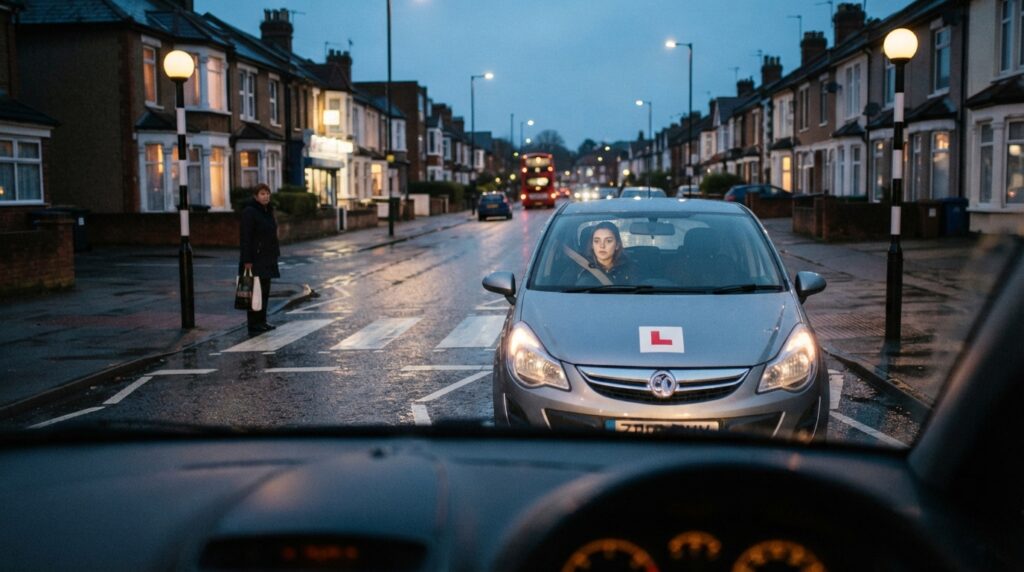
2. What do zigzag lines on the approach to a pedestrian crossing mean?
Answer: Do not park or overtake there. Keeping the zigzag area clear helps drivers and pedestrians see each other as people approach or use the crossing.
When studying road-marking images, check where the lines begin and end in relation to the crossing. That position can matter as much as the marking itself.
Once you have practised these sign and marking questions, the Theory Test is the next step from revision to assessment. Check the current fee on the Theory Test page as part of your preparation, alongside learning the rules rather than guessing from a picture.
Motorway rules: emergency areas and reflective studs
Motorway questions can turn on a specific procedure or on the position of a coloured stud. Establish the direction traffic is travelling before you decide what a colour means.
3. What should you do before rejoining a motorway from an emergency area?
Answer: Use the emergency telephone to contact the operator and follow their advice. Rejoin only when it is safe, signal clearly and build speed appropriately as you merge with traffic.
An emergency area is not a place to pull straight back onto the motorway without following the procedure. The telephone advice helps you decide how and when to rejoin safely.
4. What do the colours of motorway reflective studs mark?
Answer: Red marks the left edge, amber marks the edge by the central reservation, white marks lane lines, and green marks slip roads or lay-bys. Use the stud’s colour and location together to identify what it is marking.
In a diagram, first locate the central reservation and any slip road, then establish the direction of travel. This stops YOU mixing up colours that appear on different sides of the carriageway.
Did You Know?
Theory test pass rates increased slightly in 2023/24, rising to 45.2 per cent.
Source: Auto Express
Overtaking and pedestrian crossings
These questions test whether you can apply a rule to the traffic or signal in front of you. Do not treat overtaking on the left as always allowed or always prohibited.
5. When may you pass another vehicle on the left?
Answer: In slow-moving traffic, you may keep up with your lane if it is moving faster than the lane to your right; on a one-way street, traffic may pass on either side. These allowances depend on the road and traffic conditions.
Do not weave between lanes or move left just to overtake when it is unsafe. Keep a safe following distance and stay alert for vehicles changing lanes or turning.
6. How do pelican and puffin crossing signals differ?
Answer: A pelican crossing has a flashing amber phase after red; a puffin crossing uses sensors and has no flashing amber phase. At a pelican crossing, you may proceed on flashing amber only if the crossing is clear, and you must give way to anyone still crossing.
At either crossing, obey the signal and watch for pedestrians. A green light does not prove the crossing is clear, so check the road before moving.
Dual carriageways and towing a trailer
Questions about turning across a dual carriageway test your judgement of space. Trailer questions test whether you can apply lane restrictions and prepare the vehicle and load properly.
7. What should you check before turning right onto a dual carriageway?
Answer: Judge the gap in both directions and make sure the central reservation has enough room for your whole vehicle. If your vehicle will not fit fully in the refuge, wait until you can cross both carriageways safely in one manoeuvre.
Check the central reservation’s length before committing to the turn. Slowing down and taking a proper look at every junction removes the single biggest nerve-induced trap.
8. Which lane may a car towing a trailer use on a motorway with three or more lanes?
Answer: It must not use the right-hand lane, unless signs or circumstances such as roadworks direct otherwise. Plan your route and lane choice early so you are not making a sudden move as an exit approaches.
Before towing, check the vehicle and trailer are within their permitted weights, the coupling and lights work, and the load is secure. Towing speed limits are lower than those for cars without trailers, so check the current rules before setting off.
Harder theory-test questions may also connect vehicle documents with roadworthiness and legal responsibilities. Know when a vehicle must be taxed, insured and covered by an MOT, and distinguish those requirements from the physical checks needed before towing.
Theory Test Part 1 helps explain why close reading matters in questions like these. The multiple-choice part lasts 57 minutes and requires candidates to answer 50 questions, including three about a short video.

Vehicle condition and fuel-efficient driving
Some of the hardest UK theory test questions describe a symptom or ask you to choose an economical driving habit. In both cases, pick the response that protects control and safety.
9. What might vibration through the steering wheel at speed indicate?
Answer: Unbalanced wheels are one possible cause. Arrange for the wheels to be checked instead of assuming the problem is poor alignment or ignoring a change in how the vehicle handles.
A symptom can have more than one cause, so a theory question may be testing whether you avoid jumping to a definite diagnosis. Focus on what the driver should do next, not on guessing at a fault.
10. Which driving technique helps reduce fuel consumption?
Answer: Accelerate and brake smoothly, anticipate traffic to avoid unnecessary braking, and use a suitable gear without labouring the engine. This gives you time to respond to changing traffic while avoiding needless speed changes.
Do not try to save fuel by compromising control or leaving too little room to stop. A safe following distance and steady attention come first.
Did You Know?
The test is now 57 minutes long with a three-minute break before the hazard perception test.
Source: Wheels-Alive
Practise the reasoning, not just the answer choices
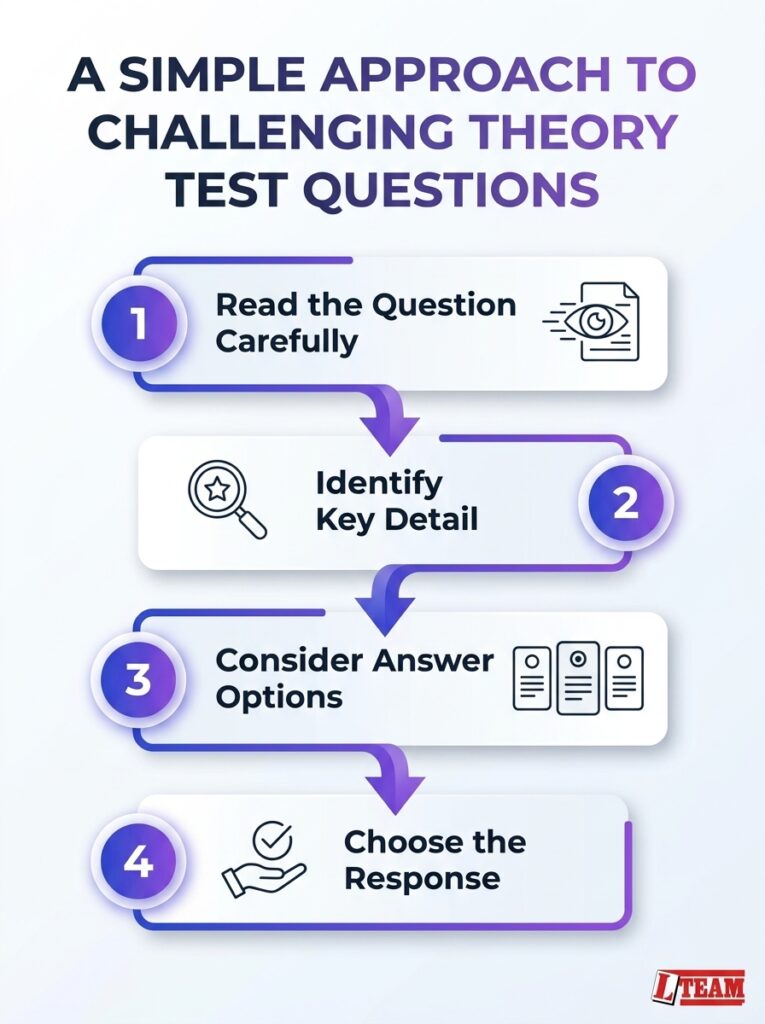
Treat each answer as a way to learn how to read the next scenario. After every practice question, explain why the correct answer applies and why the alternatives do not.
For each wrong option, ask whether it breaks a condition in the scenario, such as the type of road, direction of travel or whether the crossing is clear. A distractor may describe a genuine rule but apply it in the wrong setting; naming the mismatch is a better check of understanding than recognising a familiar phrase.
- Notice words that set conditions, such as when safe or unless.
- For a sign or road-marking image, inspect the border, background, symbol and position before choosing.
- For a scenario, identify what is happening first, then apply the relevant Highway Code rule.
- When a question describes a vehicle problem, distinguish a possible cause from a certain diagnosis.
The ten questions below are a practical selection of scenarios where a missed condition can change the answer, not a statistically verified ranking of the hardest questions. Treat them as practice in applying rules, not predictions of the exact questions YOU will see. Our aim is to help you become test-ready through practice that builds confidence and calm.
You must meet the separate pass mark in both the multiple-choice and hazard-perception sections; passing one does not make up for falling short in the other.
Multiple-choice questions test your knowledge of rules; hazard perception tests whether you recognise developing hazards in video clips. Practise both skills, and use current official guidance for rules or vehicle requirements that may change.

Stopping distances: understand the parts
Stopping distance is the distance travelled while you react and then brake. Thinking distance depends on how quickly you notice and respond; braking distance depends on vehicle speed, tyre and brake condition, road surface, weather and slope. Do not treat a memorised figure as a guarantee of the space you need.
For questions, separate the two parts first, then consider what changes them. Wet or icy roads, worn tyres, poor brakes, fatigue or distraction can leave you needing substantially more room. Leave a generous gap and increase it when visibility or grip is reduced; a safe following distance matters more than matching a textbook estimate.
Confident
Apply the Highway Code to each situation rather than memorising a set of choices as you work through the questions. Check the conditions, keep practising hazard perception and give yourself time to settle nerves.
Everyone’s journey to test is different, but our aim is to help YOU pass ASAP/SAFE. A calm, rested brain makes fewer panic-driven mistakes, and steady practice helps you make confident decisions on the road.
Frequently Asked Questions
Can you flag a theory-test question and return to it later?
Yes, you can mark a multiple-choice question for review and return to it before finishing that part of the test. Use the review screen to check flagged and unanswered questions before you submit.
What happens if you pass the multiple-choice section but fail hazard perception?
You must pass both parts to pass the theory test. If you fail hazard perception, you need to book and take the full theory test again rather than carrying your multiple-choice result forward.
How long is a theory-test pass certificate valid?
A theory-test pass certificate is valid for two years from the date you pass. You need to pass the practical test within that period or take the theory test again.
Can you use an interpreter or request support during the theory test?
You cannot use an interpreter to translate the test for you. If you have a disability or reading difficulty, you can request an approved adjustment through the test service before your appointment.
How soon can you retake the UK driving theory test after failing?
You can book another test, but you must wait at least three working days before sitting it. Use that time to review the rules behind the questions you found difficult and practise the section you did not pass.
Is a strong practice score a guaranteed pass?
No. A strong practice result is encouraging, but it cannot guarantee the result of the live test. Use practice to check that you can explain why an answer is right, meet the pass requirement in both parts and recognise developing hazards, rather than relying on one high score.
Need to book a Driving Lesson?
Contact us Now
Tel: 03334049786