
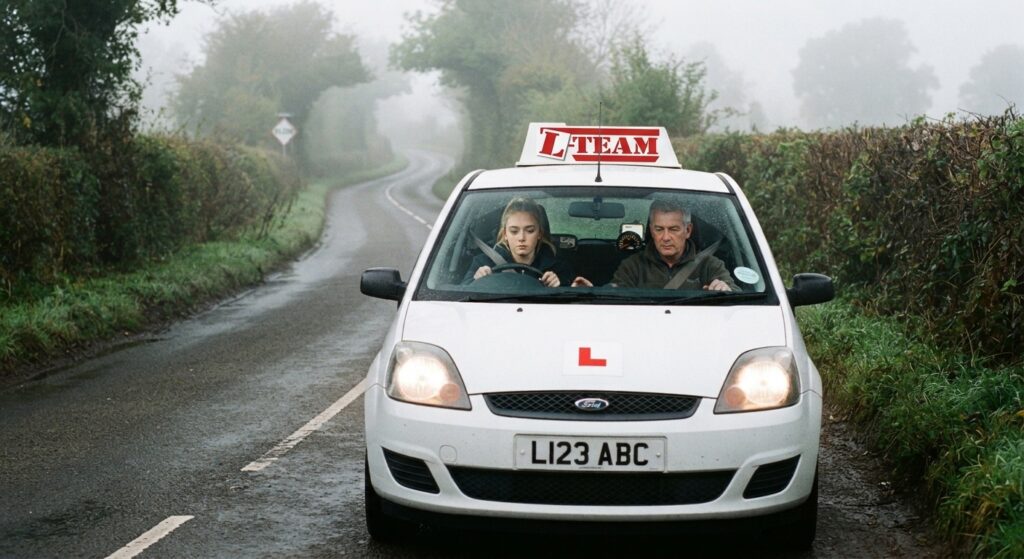
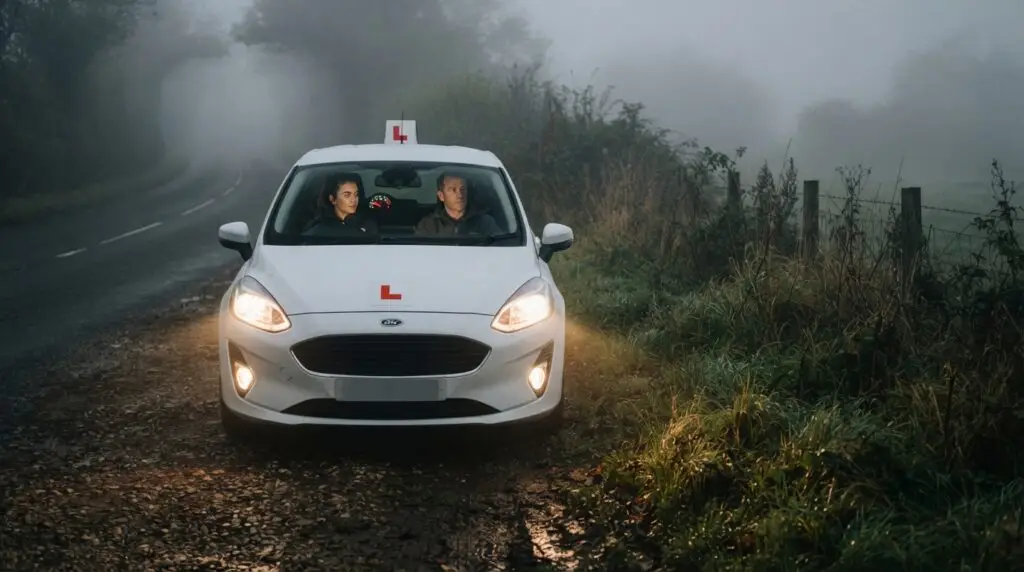
Driving Lessons in Fog: A Learner’s Guide to Visibility, Lights and Safe Following Distance gives you a practical way to prepare, choose a safe speed and respond when the view ahead changes. Fog can settle nerves, but steady decisions and a clear plan help YOU stay in control.
Key Takeaways
- Before setting off: Check the forecast, clear every window and mirror, and know how to use your lights and demister.
- For safe speed: Slow down until you can stop within the clear road you can see. Leave extra room on wet roads and in darkness.
- For fog lights: Use dipped headlights, not full beam. Switch fog lights off as visibility improves.
- For following distance: Leave more space than in clear conditions and never treat the vehicle ahead’s tail lights as proof the road is clear.
- At junctions: Approach slowly and wait until you can see that entering is safe. Avoid overtaking and unnecessary lane changes.
- For learner support: Tell your instructor if you are struggling to judge visibility, and pause or postpone if conditions exceed your experience. Our Driving Lessons Manchester are tailored to learners’ requirements and experience.
Prepare before setting off
Check the forecast before you travel, including any local Met Office fog warning. If dense fog is forecast or conditions are likely to worsen, consider delaying your journey; darkness reduces what you can see, while wet roads make it harder to stop.
Clear the windscreen, side windows and mirrors before moving. Use the windscreen demister to clear condensation, and the wipers to remove moisture, so fog outside is not made harder to manage by a misted or wet windscreen inside.
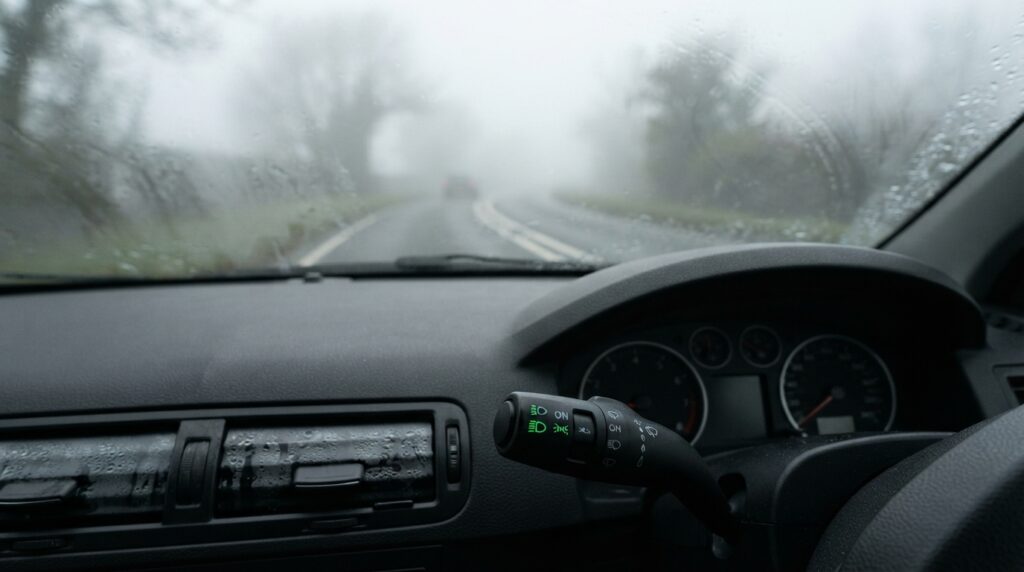
Plan a route that gives you suitable places to stop if you need to, and check you know where the route offers safe exits or off-road stopping places. Before setting off, locate the controls for dipped headlights and fog lights; you should not need to search for them when visibility is already poor.
These driving in fog tips UK learners can use are simple, but they matter: start with a clear view, a sensible route and lights you can operate confidently. Our aim is to help you make safe decisions, not to push through conditions that are beyond your experience.
Match your speed to the distance you can see
Do not choose your speed by looking at the limit or copying the car ahead. Reduce speed until you can stop within the stretch of clear road visible in front of you; if that road ends before your stopping distance does, slow down further.
Keep scanning well ahead and reassess as the fog changes. In practice, safe speed means allowing enough time and space to notice a hazard, react and stop before reaching it, rather than relying on a fixed speed that may be too fast for the view.
Leave extra stopping distance on wet roads, where reduced grip makes stopping harder. In darkness, or when headlights from other vehicles create glare, ease off earlier because objects and changes in the road can be harder to pick out.
Fog can be patchy. A brief clear stretch is not a signal to accelerate, because another dense patch may be just ahead; keep your speed measured until you have a sustained, clear view of the road.
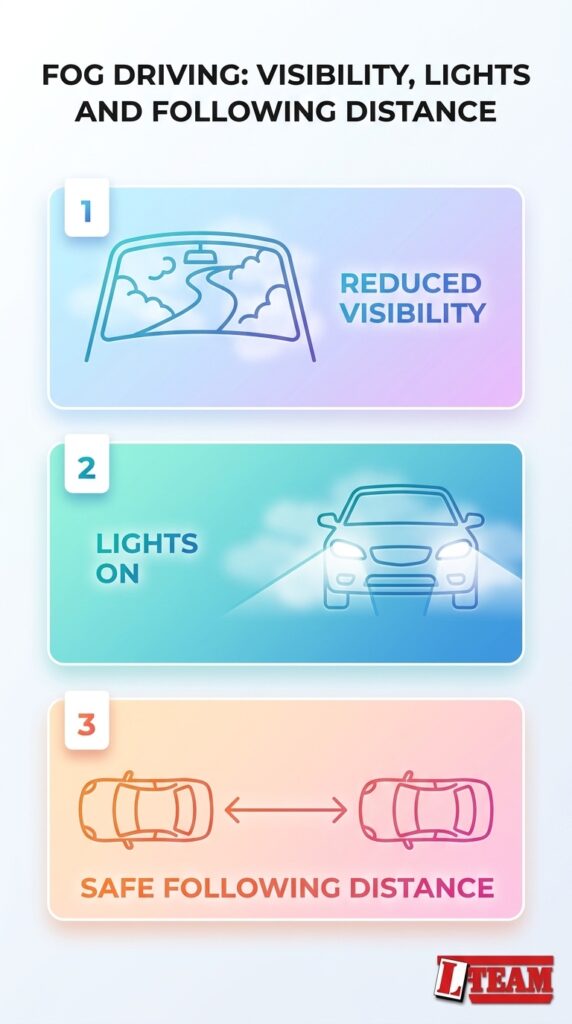
This infographic highlights how learner drivers can manage visibility, use lights appropriately, and maintain a safe following distance in fog.
Choose headlights and fog lights carefully
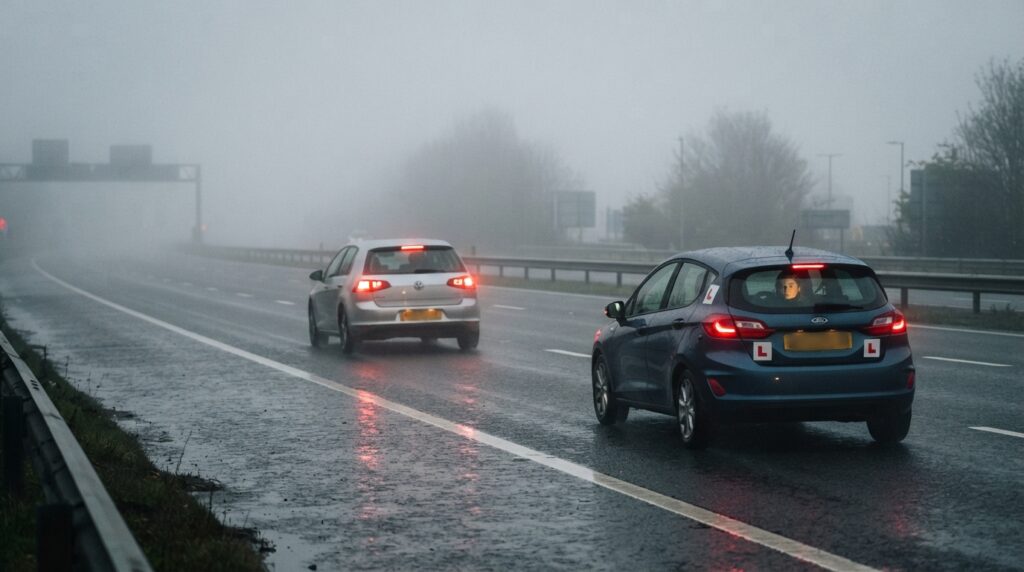
Use dipped headlights in fog. Full-beam headlights can reflect off the fog and send light back towards you, making it harder to see the road and other vehicles.
Rule 226 of The Highway Code says headlights must be used when visibility is seriously reduced, generally when you cannot see for more than 100 metres (328 feet). Front fog lights and rear fog lights are for seriously reduced visibility below that distance, as explained by National Highways.
Switch fog lights off as visibility improves. Rear fog lights are bright, so leaving them on when they are no longer needed can dazzle drivers behind and make your brake lights harder for them to distinguish.
Check that your dipped headlights are actually on. Automatic lights or daytime running lights may not provide the lighting you need in fog, so use the controls to select dipped headlights.
For learners who benefit from structured teaching and supportive guidance, Automatic driving lessons in Tameside are tailored to learners’ needs and include practical skills. That teaching structure can help YOU build confidence with car controls and road awareness before you face more demanding conditions.
Leave a larger gap and avoid following tail lights
Leave more space than you would in clear conditions. The dry-road two-second gap is a starting point, not a target for every situation; add room for fog, wet surfaces and the shorter view ahead.
Keep enough distance to stop within the clear road you can see. The vehicle in front may be able to see further than you, or may brake suddenly; its rear lights do not prove the road ahead is clear or safe.
If a driver behind is too close, do not speed up to satisfy them or brake sharply to make a point. Maintain a steady, safe speed, and let them pass only when there is a clear and safe opportunity.
Did You Know?
Research on roadways in the UK concluded that despite a 20% decrease in the amount of traffic in dense fog, there was a 16% increase in personal injury crashes.
Source: Accident Analysis & Prevention
Approach junctions and road markings cautiously
Slow down early as you approach a junction, because fog can hide approaching traffic until it is close. Do not enter until you can see that it is safe, and never edge out on the assumption that another driver will stop.
Use visible road markings to help you hold your position, but keep scanning the road rather than staring down at the lines. Markings can guide your lane position; they cannot show you whether a vehicle, pedestrian or obstruction is ahead.
Avoid overtaking and unnecessary lane changes when you cannot see far enough to judge the space ahead. Fog can hide vehicles, bends and changes in road layout, so do not rely on sound as a substitute for a clear view of the road.
If the fog thickens, find a safe place to stop
Ease off the accelerator and increase your following gap as soon as visibility worsens. Avoid abrupt braking or steering unless an immediate hazard leaves you no safe alternative.
If you can no longer continue safely, leave the road at a suitable exit or pull fully into a safe off-road place. Do not stop in a live lane, where other drivers may have too little time to see and avoid you.
For motorway driving, do not stop on the hard shoulder simply to wait for fog to clear. If conditions allow, continue to a safe exit or service area; use an emergency area or the hard shoulder only when necessary.
If visibility improves briefly, keep your speed measured. Wait until you have a sustained, clear view of the road ahead before considering any change in pace.
Make fog practice appropriate for a learner
Tell your instructor promptly if you find visibility difficult to judge. Agree on a safe place to pause or stop rather than trying to push through discomfort; a calm decision gives you and your instructor time to assess what to do next.
Postpone or adapt a lesson when dense fog, darkness or wet roads create conditions you are not ready to manage safely. There is no benefit in treating severe fog as a test of nerve: build your confidence gradually in manageable conditions.
Learners may drive on motorways only with an approved driving instructor in a dual-controlled car. Fog does not change that restriction, and motorway driving is not suitable if the journey itself cannot be judged safe.
Manual driving lessons include clutch control, smooth gear changes and managing speed safely in different traffic conditions. These skills support steady control as road and traffic conditions change, while giving you the chance to develop at a suitable pace.
Our patient, specialist instructors offer driving lessons built around confidence and calm. This is done by having an INDIVIDUAL SYLLABUS written for YOU once we have assessed how quickly you pick things up, so practice can progress without asking you to take on more than you are ready for.
Frequently Asked Questions
Are driving tests automatically cancelled when it is foggy?
No, fog does not automatically cancel every practical driving test. The test may be postponed if conditions make it unsafe to conduct, so check for official updates before travelling to the test centre.
Should I use hazard warning lights while driving in fog?
No, hazard lights are not a substitute for dipped headlights or fog lights, and they can make your intended direction less clear to other drivers. Use them to warn traffic when your vehicle is stationary and creating an obstruction, where appropriate.
Is cruise control a good idea in fog?
It is better to keep direct control of your speed, so you can adjust promptly as visibility changes. Cruise control can hold a speed that no longer suits the clear road ahead or the grip under your tyres.
What should I do if I begin to feel anxious while driving in fog?
Tell your instructor what is making you anxious and ask them to talk you through the next decision. Once safely stopped, take a few slow breaths before deciding with them whether you are ready to continue.
Can air conditioning help clear a misted windscreen?
Yes, air conditioning helps remove moisture from the cabin air, while warm airflow directed at the glass helps clear mist. Set the controls before moving, and wait until the windscreen gives you a clear view.
What is the difference between front and rear fog lights?
Front fog lights help you see the road immediately ahead in seriously reduced visibility, while rear fog lights make your vehicle easier for traffic behind to see.
Decisions
Driving Lessons in Fog: A Learner’s Guide to Visibility, Lights and Safe Following Distance comes down to decisions you can repeat: prepare the car, use dipped headlights, match your speed to the road you can see and leave extra space. If conditions worsen, choose a safe place to stop rather than pushing on.
Fog practice should build skill, not pressure. Tell your instructor when you need support, keep your choices calm and practical, and remember our aim is for you to pass as soon as you can and for us to get recommendation work, ASAP/SAFE for YOU.
Need to book a Driving Lesson?
Contact us Now
Tel: 03334049786