
Did you know that 27.7% of first aid theory test-takers get bone, muscle and joint injury questions wrong, making it the single hardest topic in the whole syllabus? Understanding Mandatory CPR & First Aid Theory Questions matters far beyond a classroom tick-box, it’s genuinely useful knowledge for anyone learning to drive, teach driving, or simply share a car with someone they love.
At L Team Driving School, our patient, specialist instructors offer Driving Lessons Manchester built around confidence and calm, and that calm extends to knowing what to do if something goes wrong on the road.

Key Takeaways
- Mandatory CPR & First Aid Theory Questions cover Basic Life Support, wound care, bone/muscle injuries and vital signs, and these are the areas where most people trip up.
- Bone, muscle and joint injury questions have the highest wrong-answer rate of any category at 27.7%, so this is worth extra revision time.
- CPR and defibrillation questions have the lowest wrong-answer rate at just 8.6%, showing that repetition and muscle memory genuinely work.
- Aspiring driving instructors going through their lesson requirements should treat first aid theory as part of their professional toolkit, not an afterthought.
- New learners benefit from basic roadside first aid awareness alongside their Driving Lessons Manchester, especially before longer solo journeys.
- Busy learners on standard or intensive lesson packages can fit theory prep into short daily sessions rather than one big cram.
- Nationally, 90% of workers say they’d take CPR and first aid training if their employer offered it, showing appetite is high, it’s access that’s often missing.
Why Mandatory CPR & First Aid Theory Questions Matter for Every Manchester Driver
Learning to drive isn’t only about mirrors, signals and manoeuvres. It’s also about what YOU do in the minutes after an incident, before the emergency services arrive.
Mandatory CPR & First Aid Theory Questions exist because someone, somewhere, needs to know the correct sequence when it counts. Our aim is for every learner who comes through our doors to leave test-ready and life-ready, not just able to reverse round a corner.
Whether you’re revising for a workplace first aid certificate, a driving instructor qualification, or simply brushing up before a long motorway drive, the theory is the same. Get the basics locked in, and the panic drains out of the situation.
Best for New Learner Drivers: Building Roadside Safety Knowledge Early
If you’re just starting out with Driving Lessons Manchester, you’re already absorbing a huge amount of new information. Adding basic first aid awareness on top might feel like overkill, but it isn’t.
We start beginners in a quiet area so we can get used to the controls of the car, and that same relaxed and comfortable environment is the right place to talk through what to do if you come across a roadside incident. A calm, rested brain makes far fewer panic-driven mistakes than a tired, anxious one, and that applies to first aid just as much as it applies to a tricky roundabout.
New drivers who understand basic Mandatory CPR & First Aid Theory Questions, even at a beginner level, tend to feel more confident behind the wheel generally. Knowing what you’d do “if” removes one more nerve-induced worry from the list.

Best for Aspiring Driving Instructors: CPR & First Aid Theory as Part of the ADI Journey
If you’re thinking about becoming a driving instructor, first aid knowledge sits alongside your DVSA-approved training as a genuine professional requirement. You’re responsible for a learner and a dual-controlled car, and that’s a level of responsibility that goes beyond just teaching clutch control.
Our own lesson requirements page outlines what’s expected of both learners and instructors, and CPR/first aid awareness is very much part of running a safe, professional operation. This is where the toughest Mandatory CPR & First Aid Theory Questions tend to appear, particularly around Basic Life Support, which makes up around 40% of a typical written theory test.
We match the service of a national school without the hefty prices, so instructors trained through us learn the full picture, not just the shortcuts.
Did You Know?
Basic Life Support content makes up around 40% of a typical CPR and First Aid written theory test, covering general concepts and CPR across all age groups.
Source: HOSA
Best for Intensive Crash Course Students: Fitting First Aid Theory Into a Tight Schedule
An intensive course keeps everything fresh in your mind and gets you on the road in just 5 to 7 days. That same principle applies to first aid theory revision.
Rather than trying to absorb everything at once, we suggest short, daily blocks of revision alongside your driving practice. Twenty minutes on Basic Life Support one day, twenty minutes on bleeding and wound care the next, keeps the information moving into long-term memory instead of falling straight back out.
Bleeding and wound care questions carry a 23.8% wrong-answer rate nationally, making them the second toughest category after bone, muscle and joint injuries. Treat these two topics as your priority revision areas if you’re on a tight, intensive timetable.
Best for Parents and Supervising Drivers: Sharing First Aid Confidence
If you’re supervising a learner between lessons, whether that’s your son, daughter, or partner, a shared understanding of basic first aid makes the whole learning process feel safer for everyone. It’s one less thing to worry about on a wet Tuesday evening drive round the Manchester area.
We often hear from parents who want to know what their learner is being taught, not just how to parallel park, but how to handle themselves if something unexpected happens. Being able to talk through Mandatory CPR & First Aid Theory Questions together, even briefly, builds a genuinely useful family safety net.
Did You Know?
60% — The weighting of the written test plan dedicated specifically to First Aid topics, including medical and environmental emergencies.
Source: HOSA
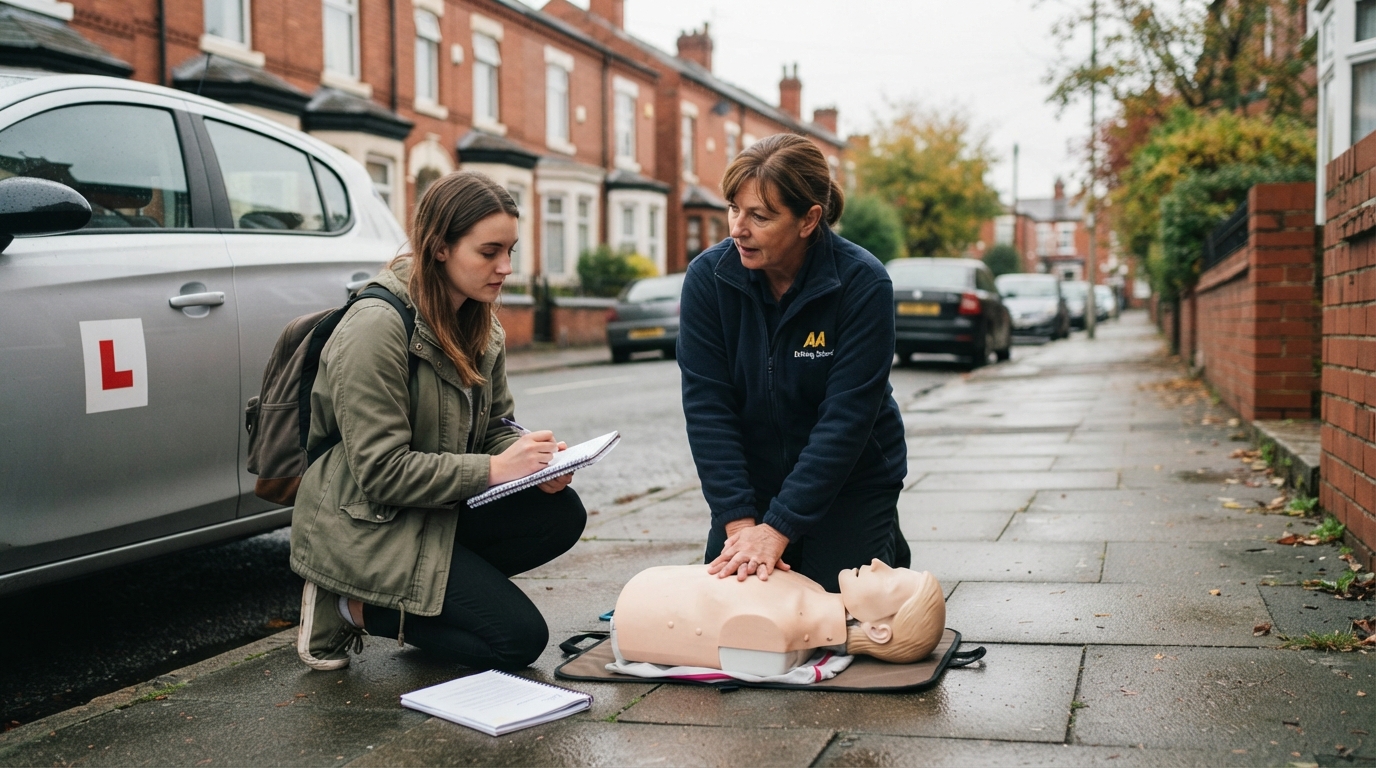
Best for Busy Professionals Taking Driving Lessons Manchester: Squeezing In Theory Prep
Many of our learners are working full time and fitting Driving Lessons Manchester around a packed diary. First aid and CPR theory revision doesn’t need to eat into your evenings if you approach it the right way.
Vital signs assessment questions have a 21.1% wrong-answer rate, often because busy learners skim through this section rather than sitting with it properly. Slowing down and taking a proper look at every question, rather than rushing through a practice paper, removes the single biggest nerve-induced trap in any theory exam.
We build an INDIVIDUAL SYLLABUS written for YOU once we’ve assessed how quickly you pick things up, and the same logic works for first aid revision. Play to your own pace, not someone else’s.
The Toughest Mandatory CPR & First Aid Theory Questions (And How to Answer Them)
Based on the data available, some topics consistently trip people up more than others. Here’s a quick breakdown:
| Topic | Wrong-Answer Rate | Revision Focus |
|---|---|---|
| Bone, muscle and joint injuries | 27.7% | Practise identifying fracture vs sprain scenarios |
| Bleeding and wound care | 23.8% | Learn pressure application and bandaging steps |
| Vital signs assessment | 21.1% | Memorise pulse, breathing and consciousness checks |
| CPR and defibrillation | 8.6% | Already the strongest area, keep practising the sequence |
Notice how CPR and defibrillation sit at the bottom of the list. That’s usually because these questions get practised the most, often physically on a manikin, which proves that repetition genuinely works for tricky Mandatory CPR & First Aid Theory Questions.
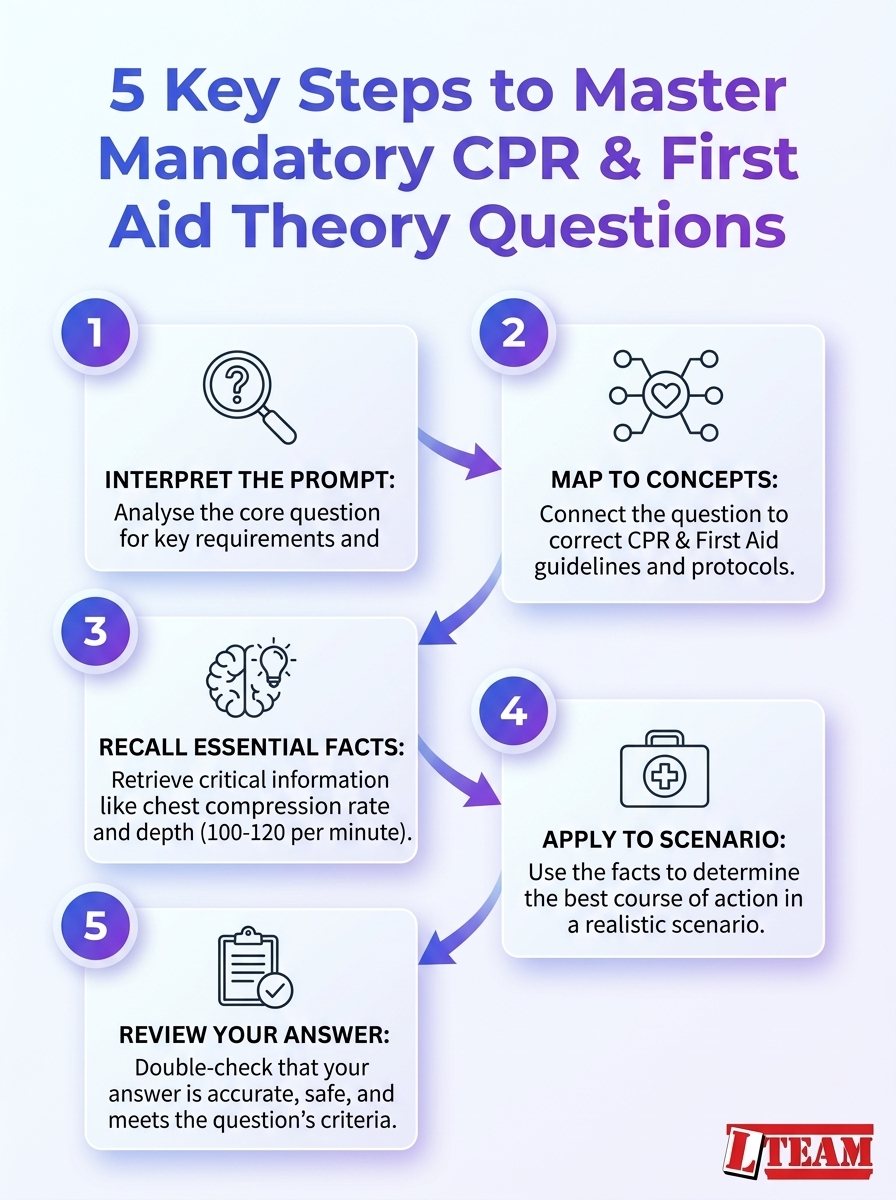
A quick visual guide to the five essential steps for mastering Mandatory CPR & First Aid Theory Questions. Perfect for exam prep and quick reference.
Best for Test Day: Calming Nerves Around Theory and First Aid Content
Test day nerves are real, whether that’s a practical driving test or a written first aid assessment. Our patient, specialist instructors offer support built around confidence and calm precisely because a nervous brain skips steps it would otherwise remember easily.
If you’re sitting Mandatory CPR & First Aid Theory Questions as part of a workplace requirement, a driving instructor qualification, or general revision, treat the morning of the test the same way you’d treat driving test day. Get a proper night’s sleep, eat something before you go, and remind yourself you’ve already put the work in.
A calm, rested brain makes far fewer panic-driven mistakes than a tired, anxious one.
Only 45% of employees have actually received formal first aid training, despite roughly 10,000 workplace cardiac arrests happening every year. That gap is exactly why taking the theory seriously, rather than skimming it the night before, genuinely matters.
How L Team Driving School Supports Your Full Test-Ready Journey
THE L TEAM DRIVING SCHOOLS MISSION is to get you there ASAP/SAFE for YOU, and that covers more than just passing your practical test. We want our learners to leave with genuine road confidence, and that includes knowing the basics of what to do in an emergency.
We’re proud specialists in the Manchester driving school scene, with instructors who know local test routes inside out. If you’re weighing up your options for affordable, quality lessons, we match the service of a national school without the hefty prices, so you relax and learn at your own pace.
And once you’ve passed, PASS PLUS courses and further training are a great way to keep building on what you’ve learned, first aid awareness included.
Not Just a Tick in a Box
Mandatory CPR & First Aid Theory Questions aren’t just a box to tick, whether you’re a new learner, a busy professional, an aspiring instructor, or a parent supporting someone through their driving journey. The data shows clear patterns in where people struggle, and with focused, calm revision, those gaps close quickly.
Slowing down and taking a proper look at every question removes the single biggest nerve-induced trap, in a written test and behind the wheel. If you’re ready to build genuine confidence on the roads with Driving Lessons Manchester, we’re here to help you get there ASAP and SAFE.
Frequently Asked Questions
What topics do Mandatory CPR & First Aid Theory Questions usually cover?
They typically cover Basic Life Support, CPR and defibrillation, bleeding and wound care, bone/muscle/joint injuries, and vital signs assessment. Basic Life Support alone can make up around 40% of a written theory test.
Which first aid theory topic do most people get wrong?
Bone, muscle and joint injuries have the highest wrong-answer rate at 27.7%, making them the toughest category in most Mandatory CPR & First Aid Theory Questions. Bleeding and wound care follows closely at 23.8%.
Do driving instructors need to know CPR and first aid theory?
Yes, first aid awareness is a genuinely useful part of professional responsibility for anyone teaching in a dual-controlled car. Our lesson requirements guidance touches on the wider safety expectations for instructors and learners alike.
How long does a CPR and First Aid theory test usually take?
A typical written theory test contains around 50 multiple-choice questions and allows up to 60 minutes to complete. That gives most people plenty of time to read each question properly rather than rushing.
Is CPR and defibrillation the hardest part of the theory test?
Actually, it’s usually the easiest part, with only an 8.6% wrong-answer rate nationally. This is likely because CPR gets practised physically far more often than other first aid topics, so the theory sticks better.
Can I revise for first aid theory alongside my driving lessons?
Absolutely, and many of our learners do exactly that during their Driving Lessons Manchester. Short daily revision sessions work far better than one long cram, especially if you’re on an intensive course.
Why should I bother learning first aid theory if I’m just learning to drive?
Knowing basic Mandatory CPR & First Aid Theory Questions means you’ll know what to do if you’re ever first on the scene of an incident. It’s a practical, calm-headed skill that complements safe, confident driving rather than sitting separately from it.
Need to book a Driving Lesson?
Contact us Now
Tel: 03334049786