
Fewer than 1 in 2 candidates pass the car theory test at the first attempt — the national pass rate sat at just 44.9% in 2024/25, according to DVSA data — and if you want to be on the right side of that statistic, knowing how to pass your theory test on the first try comes down to preparation, strategy, and the right support. Whether you’re already booking Driving Lessons Manchester with us at L Team or you’re just starting to think about the road ahead, this guide gives you everything you need to walk into that test centre ready.

Key Takeaways
- The national theory test pass rate is just 44.9% — preparation and structured revision are the difference between first-time success and repeat attempts.
- You must pass BOTH sections: score at least 43/50 on multiple-choice questions AND at least 44/75 on hazard perception — failing either means failing the whole test.
- The official DVSA question bank covers road signs, rules of the road, safety margins, and vehicle handling — revise all categories, not just the ones you feel confident in.
- Hazard perception is where many candidates lose marks — practising with realistic video clips well before your test date is essential.
- Theory test waiting times average around 3 weeks, so you have a short, focused runway — use it wisely with a daily revision plan.
- Your Driving Lessons Manchester sessions and your theory revision work together — what you learn on the road reinforces what you read in the Highway Code, and vice versa.
- At L Team, we carry an exceptional 90% first-time pass rate — our approach supports your theory prep as well as your practical skills, because both matter for making you a safe, confident driver.
—
What the Theory Test Actually Involves (and Why So Many Candidates Fail)
Before you can figure out how to pass your theory test on the first try, you need to understand exactly what you’re up against. The UK driving theory test has two distinct parts, and you must clear both in the same sitting.
The first part is the multiple-choice section: 50 questions drawn from the official DVSA question bank, covering everything from road signs and traffic law to vehicle safety and eco-friendly driving. The second part is hazard perception: 14 video clips showing real road scenarios, with one clip containing two developing hazards. You click when you spot a hazard emerging, and your score depends on how early you respond.
Most candidates underestimate one or both sections. They focus heavily on the multiple-choice questions, assume hazard perception is easy, and then lose vital marks on the clips. Others revise inconsistently — cramming the night before rather than building knowledge steadily over weeks. That inconsistency is exactly why the pass rate sits where it does.
The good news? With the right approach, passing your theory test on the first try is absolutely achievable. Let us walk you through it.
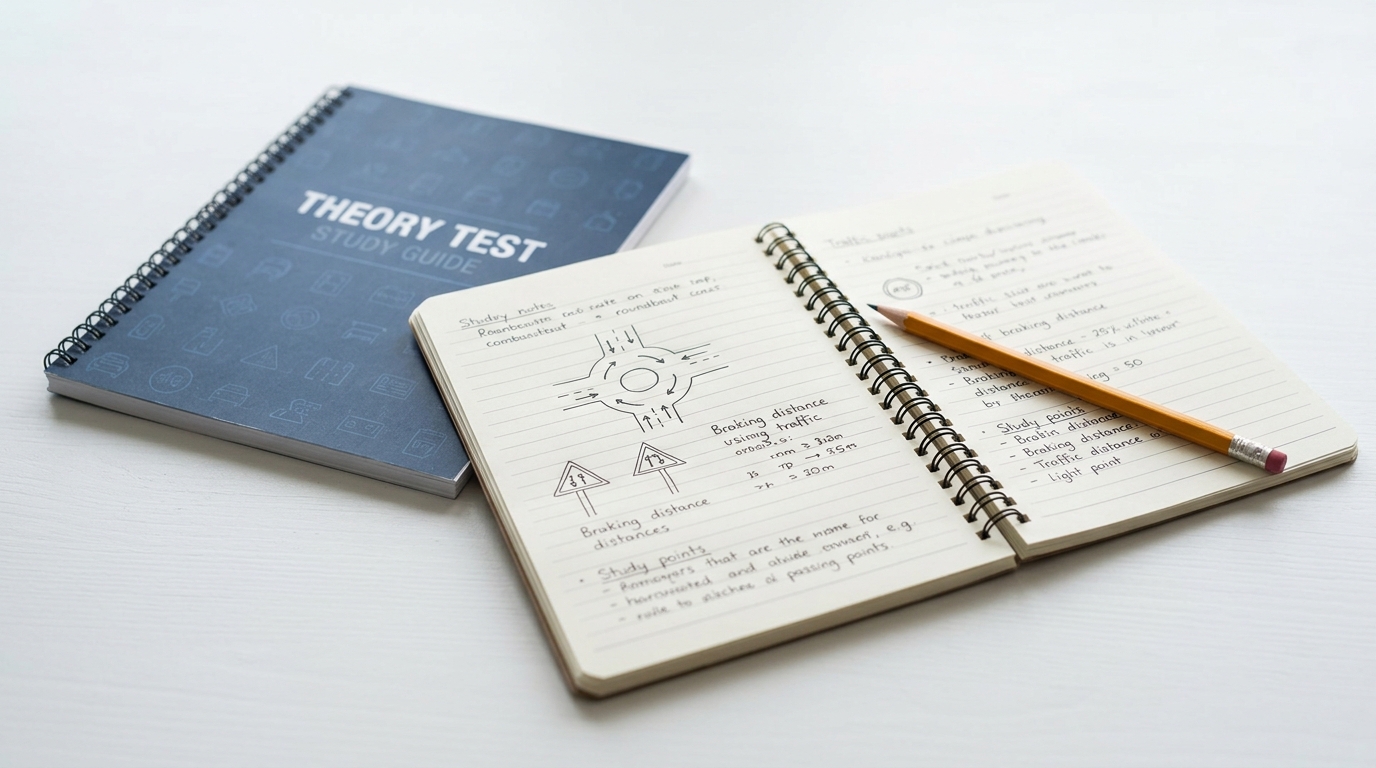
A concise 5-step guide to passing the UK theory test on the first attempt.
How to Pass Your Theory Test on the First Try: Building Your Study Plan
A structured study plan is the single biggest thing separating first-time passers from repeat testers. You don’t need months — but you do need consistency.
Here’s how we recommend you build your revision schedule:
- Start with the Highway Code. Read it cover to cover at least once. It’s not the most exciting read, but it’s the foundation of everything. Flag sections you find confusing and return to them.
- Use the official DVSA theory test practice materials. The DVSA app and website give you access to the real question bank. Work through every category — don’t skip vehicle safety or motorway rules just because you haven’t driven there yet.
- Set a daily revision target. Even 20-30 minutes of focused practice each day beats a four-hour panic session the night before. Spacing your revision helps information stick.
- Track your mock test scores. Set a target of consistently hitting 47/50 or above on multiple-choice mocks before you consider yourself ready. If you’re consistently scoring below 45, you’ve got specific areas to address.
- Schedule your test when you’re genuinely ready, not just when you want it over with. A first-time pass saves you money, time, and stress — booking too early is one of the most common mistakes we see.
With theory test candidate waiting times averaging around 3.3 weeks right now, you have a short but workable runway. Use it with intention.
Mastering the Multiple-Choice Section to Pass First Time
The multiple-choice section trips up candidates who rely on general knowledge rather than studied knowledge. Road rules are specific. Pass marks are tight. You can only afford to drop 7 out of 50 — so every question you’re uncertain on costs you.
Here’s what actually works:
- Learn the “why” behind the rules, not just the answers. When you understand why a stopping distance is what it is, or why certain road markings mean what they mean, you can answer questions you’ve never seen before — because the logic holds.
- Pay close attention to road signs. Signs questions account for a significant portion of the test, and many candidates assume they know more than they do. Work through all sign categories systematically.
- Don’t ignore vehicle safety and first aid questions. These appear regularly and are highly learnable — a short, focused session on these categories can pick up easy marks.
- Practice under timed conditions. You have 57 minutes for 50 questions — that’s generous, but mock tests under real timing conditions help you stay calm and methodical on the day.
At L Team, we don’t just prepare you to pass a test. We prepare you for real driving in a real city — and that means your theory knowledge gets reinforced every time you’re behind the wheel during your lessons. Theory and practical preparation aren’t separate; they work together.
Did You Know?
To pass the theory test, you must score 43/50 on multiple-choice questions AND 44/75 on hazard perception — both in the same sitting. Missing the mark on either section means a fail, regardless of how well you did on the other.
Source: Rated Driving (DVSA pass mark details)

Conquering Hazard Perception to Pass Your Theory Test on the First Try
Hazard perception is where confident candidates become complacent — and complacency causes fails. Many people assume that because they can see hazards in everyday life, they’ll naturally do well on the clips. That’s not how it works.
The scoring system rewards early identification of developing hazards — things that are going to require you to take action as a driver. The earlier you click, the higher your score for that hazard. But click too early or too frantically (the system detects irregular clicking patterns), and you score zero for that clip.
Here’s how to get hazard perception locked in before test day:
- Practise with official DVSA hazard perception clips, not third-party imitations. The real clips have a specific rhythm and style — familiarity with genuine DVSA footage matters.
- Watch each clip actively. As you practise, narrate what you’re seeing. “Parked car ahead — could pull out. Pedestrian on the left — could step into road.” This trains your hazard-spotting instinct.
- Don’t click randomly. The system flags irregular clicking and you’ll score zero for that hazard. Click deliberately when you see a genuine developing hazard.
- Remember the double-hazard clip. One of your 14 clips will contain two scoreable hazards. Don’t relax after your first click — stay alert throughout.
Your driving experience on real roads in Manchester directly improves your hazard perception score. When you’ve practised reading junctions, pedestrian crossings, and busy urban traffic in real conditions, the video clips start to feel familiar rather than surprising.
How Driving Lessons Manchester Help You Pass Your Theory Test
Here’s something many learners don’t realise: your theory revision and your Driving Lessons Manchester are not two separate tracks to manage. They’re the same journey, approached from different angles.
Every time you practise a manoeuvre, work on your mirrors-signal-manoeuvre routine, or navigate a busy junction, you’re reinforcing the theory knowledge you need for the test. Stopping distances make more sense when you’ve experienced them. Road sign recognition becomes automatic when you see signs on real roads every lesson.
At L Team, we take pride in our exceptional 90% first-time pass rate — surpassing the national average by more than double — and a big part of that comes from the way we structure our lessons. We don’t separate “test prep” from “real driving.” An INDIVIDUAL SYLLABUS written specifically for each student, combined with our advanced knowledge of Manchester’s roads and routes, means we prepare you for the practical reality of driving, not just the paperwork.
Whether you’re a complete beginner or brushing up on your skills, we will get you to test standard and beyond, fully prepared for every aspect of driving in Manchester.
If you’re currently working toward your theory test alongside your intensive driving course, talk to your instructor. We can point you toward the areas of the Highway Code that are most relevant to the routes you’re practising — that kind of integration is exactly what gives our students the edge.

The Best Study Resources to Pass Your Theory Test First Time
Not all theory test revision resources are equal. Some give you outdated questions; others don’t reflect the actual DVSA question bank. Here’s what we recommend:
- The Official DVSA Theory Test Kit app: The most reliable source of practice questions, drawn directly from the real question bank. Available on iOS and Android, it covers all categories and includes hazard perception practice.
- The Official Highway Code (GOV.UK): Available free online. Read it actively — make notes, highlight key rules, and revisit anything confusing.
- Know Your Traffic Signs (DVSA publication): A dedicated guide to road signs and markings. Essential if you find sign questions challenging.
- Mock tests under timed conditions: Whatever platform you use, always complete at least 10 full mock tests before your real sitting. Track your scores and identify patterns in the questions you’re missing.
You can also find helpful supporting materials through our driving resources page — we’ve put together guides and tips specifically for learners going through the process right now.
How to Pass Your Theory Test on the First Try: Test Day Strategy
Preparation wins the test before you walk in. But how you handle test day itself makes a real difference too.
The night before: Don’t cram. Do a single relaxed mock test to confirm your readiness, then stop. Sleep matters more than one more revision session.
The morning of: Eat something, arrive at the test centre 15 minutes early, and bring your provisional licence (both photocard and counterpart if applicable). Arriving flustered is avoidable — plan your route in advance.
During the multiple-choice section:
- Read every question fully before looking at the answers.
- If you’re unsure, flag the question and move on. Come back at the end with fresh eyes.
- Don’t second-guess your first instinct unless you have a clear reason to change your answer.
During hazard perception:
- There is a short break between sections. Use it to breathe and reset.
- Click when you see a hazard developing — not when it’s already become an emergency.
- Stay focused on every single clip. Drifting halfway through a video costs you marks.
And after you pass? Don’t let that theory certificate sit unused. Your theory test result is valid for two years — and with practical test waiting times being what they are, booking your practical test ASAP is exactly the right move.
Did You Know?
The average theory test candidate waiting time was just 3.3 weeks in 2024/25 — well within DVSA’s target of 4 weeks or less. That’s a focused, short revision window — not an excuse to start late, but a reason to start sharp.
Source: DVSA Annual Report and Accounts 2024–2025

Common Mistakes That Stop Learners Passing the Theory Test First Time
We’ve seen the patterns. Here are the most common reasons candidates don’t pass on the first attempt — and how to avoid every single one of them.
- Relying on memory from everyday driving. You might recognise many road signs, but the theory test goes deeper — marking systems, speed limits in unusual scenarios, vehicle safety checks. Don’t assume; verify.
- Skipping categories in the question bank. Every category is tested. Candidates who focus only on signs and rules of the road and ignore sections on vehicle loading, towing, or first aid are leaving marks on the table.
- Underestimating hazard perception. We’ve already covered this — but it’s worth repeating. Practice clips specifically. Don’t walk in cold.
- Booking too early out of eagerness. Enthusiasm is great. Booking before you’re genuinely scoring 47/50 consistently on mocks is a fast track to a second sitting fee.
- Not practising under timed, realistic conditions. Doing questions casually without a timer is useful early in revision. But by the final two weeks, every mock test should replicate actual test conditions.
We talk to our students about all of this during their frequently asked questions sessions — because theory prep is part of the full picture of getting you driving confidently and safely.
How to Pass Your Theory Test on the First Try Alongside Your Driving Lessons
The smartest approach is to run your theory revision in parallel with your Driving Lessons Manchester — not sequentially. You don’t need to pass theory before you start lessons (though you do need it before your practical test), and starting lessons early gives you a huge advantage when it comes to understanding the theory.
Every manoeuvre you practise, every junction you navigate, every hazard your instructor points out makes the theory content more tangible. The two reinforce each other — and at L Team, we actively build that connection into how we teach.
Whether you’re just starting your lessons or preparing for your test date, knowing the theory inside and out makes a real difference to how you drive, not just how you score on a test. That’s the point. We prepare you for real driving in a real city — and that includes the knowledge behind every decision you make at the wheel.
Get in touch with L Team Driving School today, and let’s get you ready for every road in Manchester, ASAP and SAFE.

Conclusion
Knowing how to pass your theory test on the first try comes down to one thing: treating it as seriously as you treat your practical lessons. A structured revision plan, genuine familiarity with the official question bank, focused hazard perception practice, and smart test-day strategy are the four pillars. Pair all of that with quality Driving Lessons Manchester from a school that genuinely invests in your success — and you’re not just hoping to pass, you’re prepared to pass.
At L Team, we do not just prepare you to pass a test. We prepare you for real driving in a real city, and that includes everything that city throws at you. Our exceptional 90% first-time pass rate exists because we approach every student with an INDIVIDUAL SYLLABUS, built around their pace, their goals, and their test readiness — theory knowledge included.
Do not let the theory test be the thing that holds you back from getting behind the wheel. Book your driving lessons with L Team today, and let us sort it out together — ASAP and SAFE.
Frequently Asked Questions
How long does it take to prepare to pass the theory test on the first try?
Most learners need between 4 and 8 weeks of consistent daily revision (20-30 minutes per day) to be genuinely ready to pass the theory test on the first try. The key is working through the full DVSA question bank and practising hazard perception clips regularly — not cramming everything into a few days.
What is the pass mark for the UK theory test?
You need to score at least 43 out of 50 on the multiple-choice section and at least 44 out of 75 on hazard perception — and you must pass both in the same sitting. Passing one section but failing the other means a fail overall, and you’ll need to retake the full test.
Is the hazard perception test hard to pass?
Hazard perception catches out many candidates who underestimate it. The key is practising with official DVSA clips so you understand the scoring system — clicking too early, too late, or in irregular patterns all cost you marks. Focused practice with genuine DVSA materials is the most effective way to get this section locked in before test day.
Can you pass the theory test without studying the Highway Code?
Technically possible, but not recommended and not what we’d advise. The Highway Code underpins the entire question bank, and understanding the “why” behind rules helps you answer unfamiliar questions correctly. Candidates who skip the Highway Code tend to score inconsistently on mock tests and are at much higher risk of failing.
How does taking driving lessons help you pass the theory test?
Driving Lessons Manchester give real-world context to what you’re studying in the theory — stopping distances, road signs, hazard awareness, and traffic rules all become far more meaningful when you’ve experienced them from the driver’s seat. At L Team, our instructors actively reinforce theory knowledge throughout practical lessons, which is a big part of why our students pass at more than double the national average rate.
What happens if you fail the theory test?
If you don’t pass the theory test first time, you can rebook after 3 working days — but you’ll need to pay the full fee again (currently £23 for cars). That’s why genuine preparation matters: a first-time pass saves you money, time, and the stress of starting your revision cycle over.
Do driving lessons count toward passing the theory test on the first try?
Driving lessons don’t directly count as theory revision, but they have a significant indirect impact. Real road experience builds hazard perception skills, road sign recognition, and rule comprehension that makes theory revision faster and stickier. The learners who pass their theory test on the first try are almost always the ones whose practical and theory preparation are running in parallel.
Need to book a Driving Lesson?
Contact us Now
Tel: 03334049786